Leave It vs Drop It: The Most Misunderstood Commands in Dog Training
 Leave It vs Drop It: The Most Misunderstood Commands in Dog Training
A few years ago, I got a panicked phone call from a very small owner with a very large Rottweiler named Jake.
Jake had just proudly brought a dead squirrel through the dog door.
The owner was yelling. Jake was thrilled. She had even tried getting him to give up the squirrel by offering some dog food.
Jake was not impressed.
From Jake’s perspective, that wasn’t a fair trade.
That moment wasn’t about obedience.
It was about economics.
Dogonomics.
The First Thing Most Owners Get Wrong
Most people think “Leave It” and “Drop It” are commands you win.
They believe if they reward the dog for giving something up, the dog is training them. They worry the dog is “getting what they want.”
But here’s the truth:
Leave It and Drop It only work long-term when they function as a partnership.
If it feels like a fight, you’ll eventually lose.
If it feels fair, you’ll both win.
This isn’t about dominance.
It’s about building something that actually holds up under pressure.
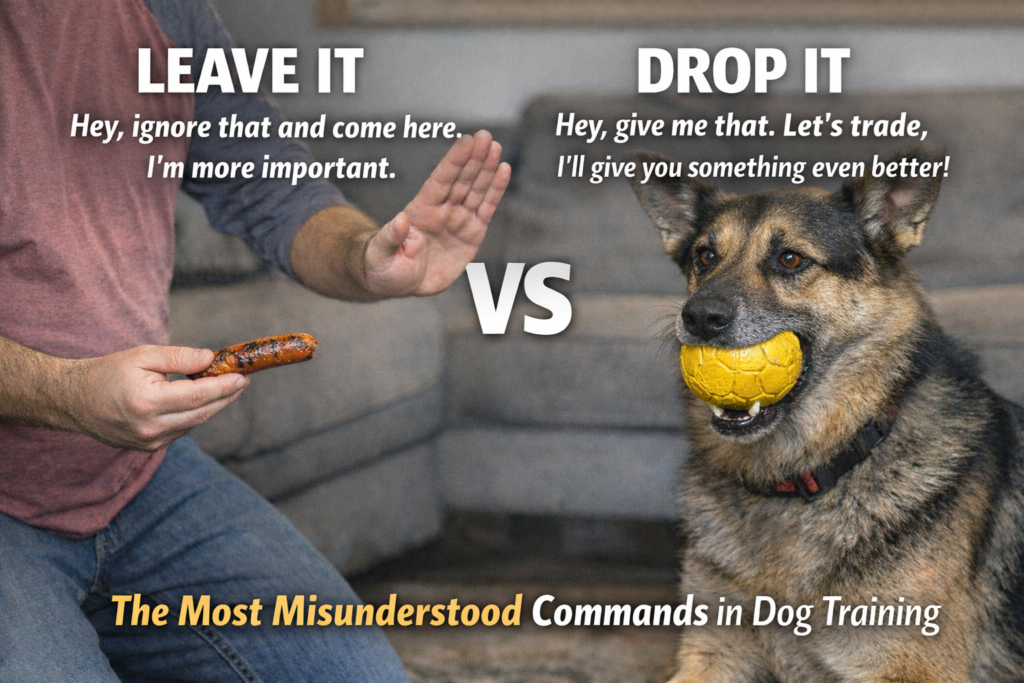
The Critical Difference Between Leave It and Drop It
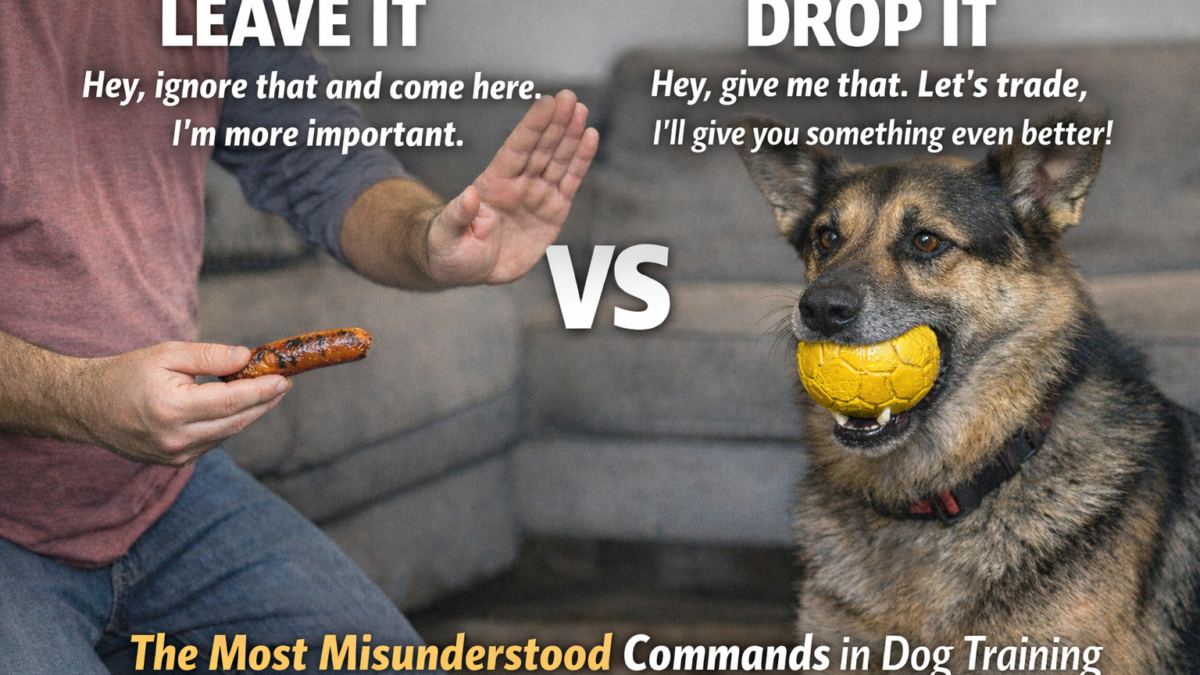
Before anything else, we have to separate these two commands. They are not interchangeable.
Leave It
-
Pre-mouth.
-
The dog has not committed.
-
You are asking for disengagement.
-
“Walk away from that and come back to me.”
Drop It (or Trade)
-
Post-mouth.
-
The dog already has the item.
-
You are asking the dog to willingly give up a resource for something of equal or greater value.
-
This is negotiation.
They’re different skills.
But the discipline you build with Leave It shows up when you need Drop It.
Dogonomics: Value Is Determined by the Dog
If your dog has a dead squirrel and you offer a piece of kibble, you are asking the dog to trade down.
Now if you’re holding a Johnsonville brat in your hand?
Now you have leverage.
Dogs do not give things up because you told them to.
They give things up when the exchange makes sense to them.
And value is determined by the dog — not by you.
You’re not losing when you make it fair.
You’re building a history of exchanges that make future cooperation easier.
That’s leadership.
Why It Eventually Looks Easy
If you practice this.
If you’re consistent.
If you make exchanges fair.
If you rehearse it in stages.
Eventually, it will look like your dog just gives things up.
It’s not magic.
It’s repetition.
It’s consistency.
It’s fairness over time.
It’s reinforcement history.
No practice. No homework. No magic.
Leave It Is Easier Than Drop It
It’s always easier to get the dog to redirect before they get to the item.
Before they grab it.
Before they put it in their mouth.
Before they start interacting with it.
Leave It happens pre-mouth.
Once the dog gets the item in their mouth, the value changes.
Now it’s a resource the dog possesses.
And once a dog possesses a resource, it almost always becomes more valuable than it was a second earlier.
That’s what makes Leave It easier than Drop It.
Pre-mouth, you’re redirecting.
Post-mouth, you’re negotiating over something the dog already owns.
Environment Matters More Than You Think
Start in the house.
Then the backyard.
Then the front yard.
Then the driveway.
Then the walk.
Each layer adds distraction.
Each layer adds difficulty.
Each layer tests timing.
Most owners try to use Leave It on a walk before they’ve taught it in controlled environments.
You don’t teach algebra before teaching order of operations.
If you skip layers, don’t be surprised when it collapses under pressure.
Take It One Step Further: The No-No Bucket
You don’t have to wait for your dog to steal something to practice.
Create setups the dog can handle.
A No-No Bucket is simply a collection of safe household items your dog would normally grab — old remotes, paper towels, broken glasses, harmless junk that’s tempting but not dangerous.
The first reps should be on leash.
That way the dog cannot actually get to the item.
Now you control distance.
You control access.
You control success.
You’re practicing Leave It before the dog reaches the object.
If you want to see exactly how this looks in real time, watch this demonstration of Leave It on leash:
https://www.youtube.com/watch?v=3gKbvTICzhE
You’re not testing the dog.
You’re teaching the dog.
If you don’t practice it, don’t expect it to show up when it matters.
Timing and Genetics Matter
Teaching a puppy to trade is very different from retraining a four-year-old dog who has guarded items for years.
Earlier structure lowers the probability of conflict.
It does not eliminate genetics.
Some dogs are wired to value objects more intensely. Some have long rehearsal histories that make release harder.
You cannot guarantee outcomes.
But you can shape probability.
FAQ
Should I always trade with my dog?
Here’s the deal.
Early on, yes.
If you’re teaching Drop It, you need to make it worth the dog’s while.
Over time, when you’ve practiced it enough and built a fair history, it won’t feel like you’re trading every single time.
It will just look like your dog gives things up.
But that doesn’t happen by accident.
It happens because you did the reps.
No reps, no reliability.
When can I stop using treats?
When can your boss stop writing you a paycheck?
If it’s a positive, wanted behavior, you should be rewarding it.
Now, does that mean it has to be food every single time?
No.
Reward doesn’t always mean kibble.
It could be:
-
A kind word
-
A scratch behind the ears
-
A game of fetch
-
A game of tug
-
Access to something they want
But the idea that we can stop rewarding behavior we like and expect it to continue reliably?
That’s not how learning works.
You don’t build partnership by removing the paycheck.
Work With a Professional
If you’re working with a dog struggling with possession, guarding, or impulse control and you’re looking for a dog trainer in Kansas City, structured in-home coaching makes a difference:
https://kissdogtraining.com/dog-trainer-kansas-city/
Winner – Best Dog Trainer in Johnson County (2023, 2025)
https://bojc2025.johnsoncountypost.com/pets/dog-trainer
Final Thought
If you approach these commands as fights, you’ll create tension.
If you approach them as fair exchanges, you’ll create trust.
Dog training isn’t complicated — you just need a little more information.