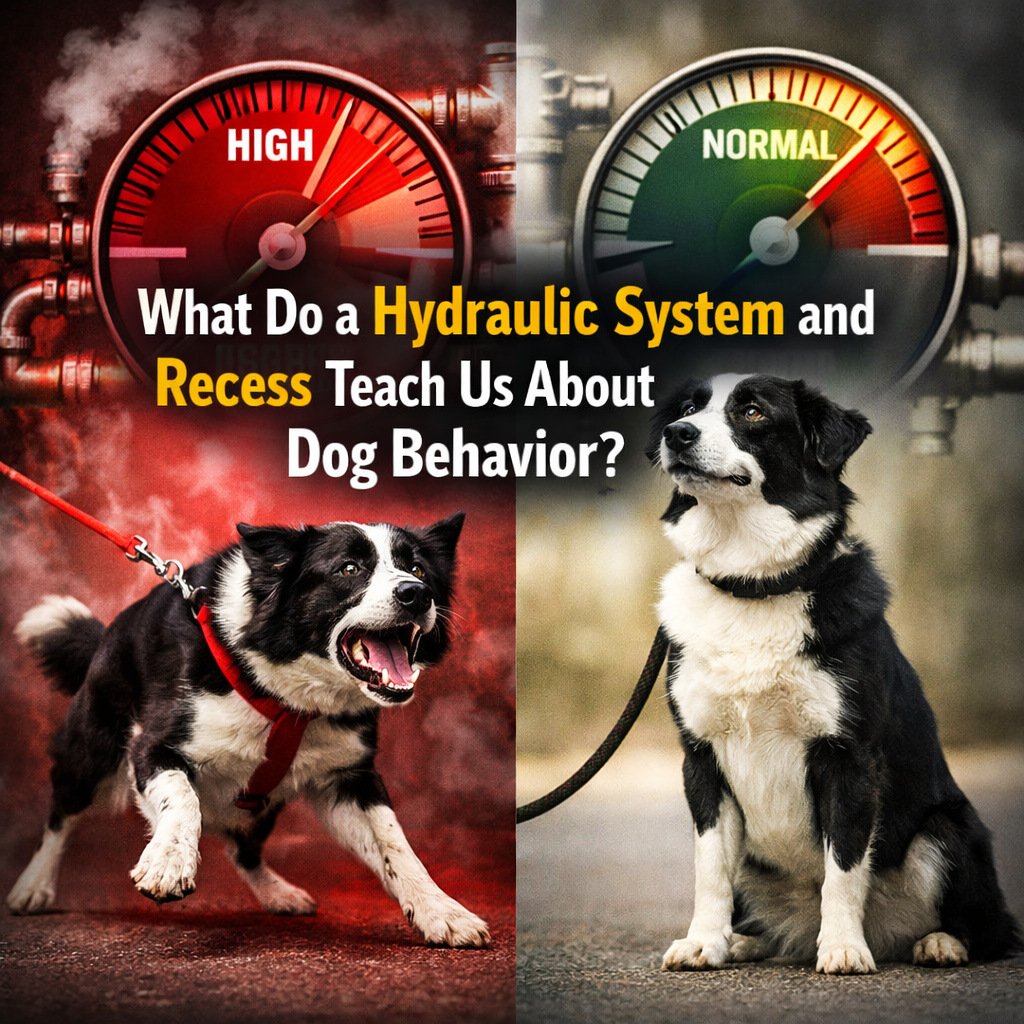
 What Do a Hydraulic System and Recess Teach Us About Dog Behavior?
More than you think.
Every hydraulic system has pressure tanks.
When pressure builds inside a sealed system, it doesn’t disappear. It rises. And if it rises high enough without a relief valve, something fails.
Hoses burst.
Valves blow.
Systems shut down.
Dogs work the same way.
Every behavior has its own “tank”:
-
Leash pulling
-
Jumping
-
Barking
-
Reactivity
-
Even aggression
What starts as excess energy can turn into over-stimulation.
Over-stimulation can turn into reactivity.
Reactivity, if rehearsed long enough, can turn into aggression.
Those aren’t separate personality problems.
They’re escalating levels of pressure in the same system.
Before we label a dog as stubborn, dominant, reactive, or aggressive, we should ask:
How much pressure is already in the tank?
🐾 How Pressure Builds
Energy that isn’t burned off doesn’t vanish.
It builds.
A dog that hasn’t had appropriate physical output carries higher baseline energy. That means every tank fills faster. The excitement tank fills faster. The frustration tank fills faster. The leash tank fills faster.
When tanks are already close to full, it doesn’t take much to push them over the edge.
That’s when behavior seems to “come out of nowhere.”
But it didn’t.
It came from pressure.
🐾 The Primary Relief Valve: Exercise
In hydraulics, systems survive because they have relief valves.
When pressure approaches a dangerous level, the valve opens and releases it safely.
For dogs, the most important relief valve is exercise.
Move the dog.
Work the dog.
Lower the baseline energy.
Exercise doesn’t teach leash walking.
It makes it possible for a dog to focus long enough to pay attention to the handler. And when a dog is paying attention to the handler, walking improves.
Lower the pressure.
Then teach.
🐾 Same Lesson, Different Angle
Recess doesn’t teach math.
Recess lets kids burn off energy so they can sit still long enough to focus.
The problem isn’t always the lesson.
It’s the state of the dog — or the kid — before the lesson starts.
Exercise doesn’t teach impulse control.
It creates the conditions where impulse control can actually be learned.
No recess? Chaos.
No exercise? Over-pressurized behavior.
🐾 What Happens If You Skip the Reset?
If a dog never gets appropriate exercise, every tank runs closer to full.
Then we try to fix:
-
Leash pulling
-
Reactivity
-
Jumping
-
Barking
But we’re trying to teach skills in a system that’s already over-pressurized.
Impulse control struggles.
Calm work doesn’t stick.
Frustration rises — on both ends of the leash.
The problem isn’t always the lesson.
It’s the pressure.
🐾 Secondary Valves (After Exercise)
Exercise lowers baseline pressure across the whole system.
Then — and only then — do the secondary valves matter.
Teaching a dog to wait at a doorway, hold a sit, or pause before grabbing a toy builds impulse control.
Teaching a dog how to relax — rewarding calm posture, quiet behavior, and stillness — builds the ability to settle instead of escalate.
If you want to go deeper on building calm structure inside the home, you can explore the concept of the
Living Room Dog vs Everywhere Dog.
Creating distance when overstimulation rises allows pressure to drop before explosion.
Clear consequences matter too — meaning the reward stops, or the dog is calmly removed from the situation before pressure explodes. That prevents rehearsal of the behavior you’re trying to reduce.
These are valves.
But they regulate spikes.
They don’t replace exercise.
Lower the baseline pressure first.
Then regulate the tanks.
Kansas City Dog Owners: Get Help Applying This
If you’re dealing with leash reactivity, overstimulation, or aggression and want help applying this in real life, working with an experienced dog trainer in Kansas City can make the difference.
If you’re searching for structured, in-home Kansas City dog training, start by working with someone who understands how baseline pressure affects behavior before trying to fix the visible symptoms. You can learn more here:
Whether the issue is pulling, reactivity, or escalation toward aggression, the foundation of effective dog training Kansas City families rely on is lowering pressure first — then building structure.
Winner – Best Dog Trainer in Johnson County (2023, 2025)
🎯 Keep It Simple
It can be frustrating to feel like you have to go back to the beginning just to get your dog’s brain in the right place for training.
But without the brain being ready to learn, you’re never going to make real progress.
Complicated problems sometimes require a simple reset.
Build it from the beginning.
Exercise your dog.
By lowering that pressure.
Add those valves.
By teaching your dog to pay attention and teaching your dog to relax.
Help your dog.






Superb blog post, I have book marked this internet site so ideally I’ll see much more on this subject in the foreseeable future!
Thanks, so much for the kind words… Please pass the word along about the blog and our facebook pages at
http://www.facebook.com/kissdogtraining and http://www.facebook.com/muttzrus