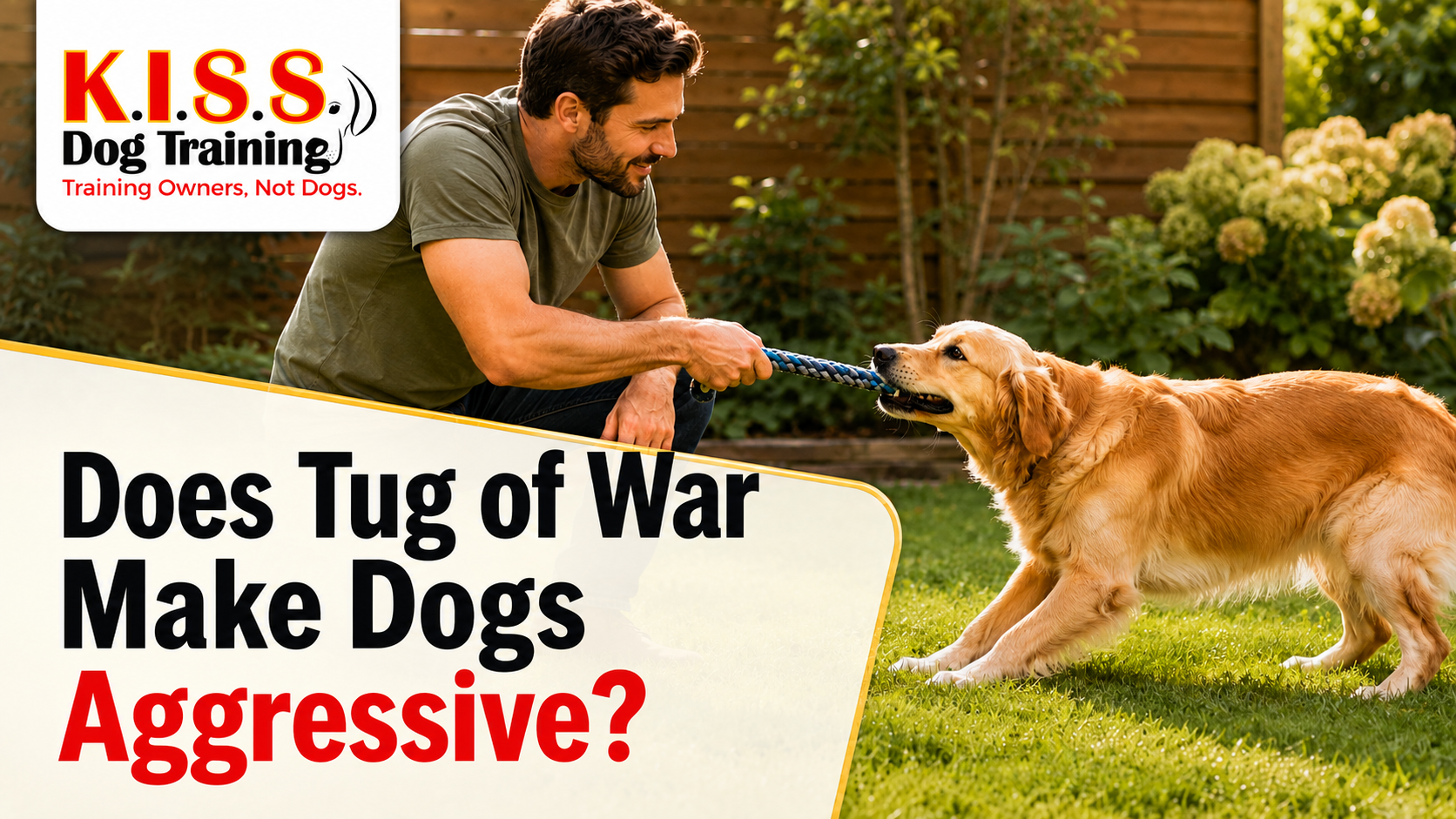
 Does Tug of War Make Dogs Aggressive?
I have heard this one for years:
“Don’t play tug of war with your dog. It will make them aggressive.”
Nope.
Playing tug does not automatically create an aggressive dog. Like most things in dog training, the problem is not usually the game. The problem is how the game is played.
If someone is roughhousing with the dog, lifting the dog off the ground, pushing the dog around, smacking at the dog, or intentionally trying to get the dog worked into a frenzy, then yes, that can create problems.
But when tug is played correctly, it can be a great teaching tool.
At K.I.S.S. Dog Training, I work with families through in-home dog training in Shawnee, Kansas, and the surrounding Kansas City area. A lot of what we do comes back to teaching dogs how to think, pause, and respond instead of just reacting. Tug can help with that when it is done with rules.
If you need help with basic manners, puppy training, impulse control, or behavior concerns, you can start here:
https://kissdogtraining.com/read-first/
Tug Can Teach More Than You Think
When done correctly, tug can help teach:
polite behavior
impulse control
wait
take it
drop it
how to calm back down after excitement
That is much more useful than simply saying, “Never play tug.”
The key is structure.
The Tug Toy Belongs to You
The first rule is simple:
The tug toy belongs to you.
That does not mean we are being mean or trying to dominate the dog. It simply means tug is an interactive game. The toy comes out when you are ready to play, and it goes away when the game is over.
The dog does not get to grab it whenever he wants, run off with it, or turn the game into a free-for-all.
When you control the start, pace, and end of the game, tug becomes useful training instead of chaos.
Step One: Say Please
Before the game starts, your dog should “say please.”
In dog language, that usually means a sit.
If Fido wants to play tug, he does not get to jump, bark, paw, or grab at the toy. He sits first.
This teaches your dog that calm, polite behavior makes good things happen.
Step Two: Wait
Once your dog is sitting, show him the tug toy and ask him to wait.
This is where we work on impulse control.
Yes, he is going to get the toy. But he does not get it just because he wants it. He gets it when he shows a little patience.
Dogs need to learn that excitement does not mean they get to lose their brains. Tug gives us a great chance to practice that in a fun, controlled way.
Step Three: Take It
After a brief wait, tell your dog, “Take it.”
This gives him permission to grab the toy.
That may sound simple, but it is an important lesson. Your dog is learning that he may take something from your hand only when invited.
That lesson can carry over into toys, treats, food, and other things your dog may want.
Step Four: Drop It
Now you can play tug.
Keep the game short and controlled. Tug should not turn into a wild wrestling match.
After a few seconds of tugging, hold a treat near your dog’s nose and say, “Drop it.”
When he lets go of the toy, reward him.
Then repeat the same pattern:
Sit.
Wait.
Take it.
Tug.
Drop it.
That is how tug becomes training instead of chaos.
What If My Dog Growls During Tug?
Some dogs growl when they are having fun. That does not automatically mean the dog is being aggressive.
However, I still want the game to stay under control.
If the dog starts getting too growly, too intense, or too worked up, ask for a “drop it,” pause the game, and let things calm down before starting again.
The goal is not to punish fun. The goal is to teach the dog how to play, get excited, and then settle back down.
Excitement is not the enemy.
Lack of control is the problem.
When to Stop Playing Tug
If anything happens during tug that makes you uncomfortable, stop the game immediately.
If your dog’s behavior does not seem like normal play, or you are worried that what you are seeing may be an aggression issue, do not keep testing it. Stop playing tug and contact a good, reputable, positive reinforcement dog trainer for help.
At that point, I would put tug on hold until you have professional guidance.
Tug can be a great game, but it is not worth pushing through behavior that feels unsafe or unclear.
Tug Safety Rules
Here are the basic rules I recommend:
- Teeth on skin ends the game.
Even if it was an accident, the game is over. Human skin is never part of the tug toy.
- The tug toy only comes out when you are playing.
This is your toy that you share with your dog. It should not be left out all day.
- Adults should control the game.
I do not recommend letting children play tug with dogs. It is too easy for the game to get too rough or too exciting.
- Keep the game short and controlled.
Tug should be fun, but it should not become over-the-top or out of control.
- Practice “drop it” often.
Do not wait until the dog is too excited. Ask for “drop it” early and often so it becomes part of the game.
Rules are rules.
Tug Is Really About Impulse Control
A good game of tug is not about making the dog wild.
It is about teaching the dog that even when something is exciting, he still has to think.
He has to sit.
He has to wait.
He has to take the toy when invited.
He has to drop it when asked.
He has to keep his teeth off human skin.
That is impulse control.
And impulse control is one of the most important things we teach in dog training.
For more help with impulse control and getting your dog to respond around distractions, this post may also be helpful:
https://kissdogtraining.com/why-your-dog-isnt-listening/
Watch Tug Used as a Training Tool
I also have a video on my YouTube channel that shows this type of structured tug work in action:
https://www.youtube.com/watch?v=dUQCna7JwsI
The point is not just to play harder.
The point is to use the game to teach rules, manners, and self-control.
The Same Rules Apply to Fetch
Many of these same rules also apply to fetch.
Your dog should still be able to wait before you throw the toy, bring it back, drop it, and keep the game under control.
Fetch, like tug, can either be a useful training game or a complete mess. The difference is whether the human sets rules and follows through.
Tug Is Not the Problem
Tug is not bad.
A poorly controlled game of tug can be a problem. But a structured game of tug can be a great way to teach manners, impulse control, and cooperation.
So no, playing tug with your dog does not automatically create aggression.
Played correctly, tug can be one of the best games you use to teach your dog how to listen even when he is excited.
If you need help teaching your dog better manners, safer play, or stronger impulse control, K.I.S.S. Dog Training offers in-home dog training in Shawnee, Kansas, and throughout the Kansas City area.
Mike Deathe has been helping families train their dogs since 2008, opened K.I.S.S. Dog Training in 2010, and K.I.S.S. Dog Training was voted Best Dog Trainer in Johnson County in 2023 and 2025.
You can learn more about training options, pricing, and how to get started here:
https://kissdogtraining.com/read-first/
The game is not the problem.
The rules matter.



Leave A Comment
You must be logged in to post a comment.