
 🐾 Updated for Kansas City Dog Owners
If you’re walking your dog in neighborhoods around Kansas City, Shawnee, or Overland Park, leash reactivity can feel overwhelming fast. Tight sidewalks, unexpected dog encounters, and busy environments make it easy to push dogs too far, too quickly. The good news is this: leash reactivity isn’t complicated—but it does require patience, consistency, and realistic expectations.
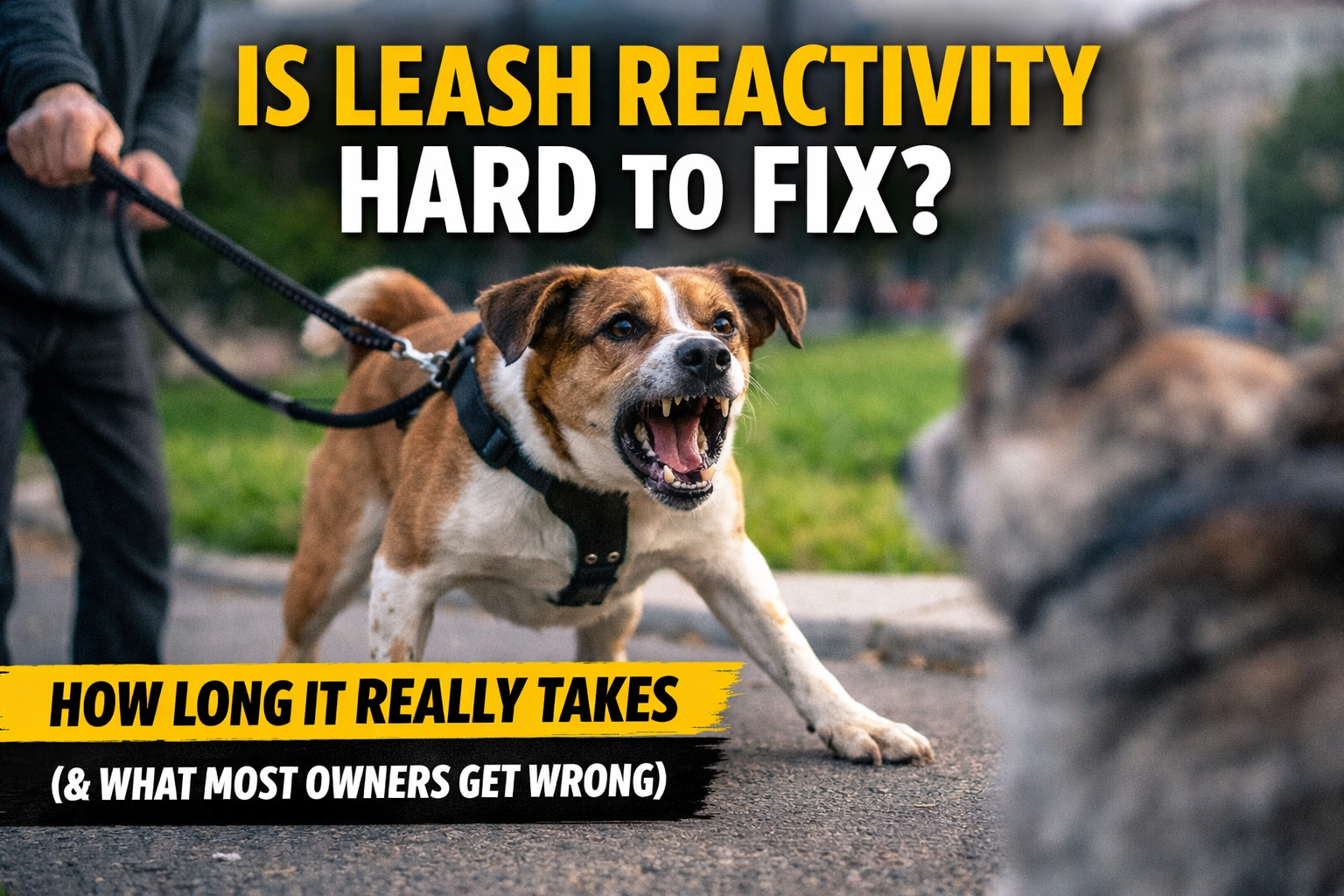
Is Leash Reactivity Hard to Fix? How Long It REALLY Takes (And What Most Owners Get Wrong)
Leash reactivity isn’t hard to fix.
But it is really hard for people to stop making it worse.
That’s the truth most dog owners don’t want to hear.
The Problem Isn’t the Dog—It’s the Pace
Most people struggling with leash reactivity aren’t dealing with a lack of technique.
They’re dealing with impatience.
They:
- Get too close too fast
- Try to “test” the dog before it’s ready
- Flood the dog and hope it works out
- Chase progress instead of building it
And every time that happens, the dog falls back on what it already knows:
react, bark, lunge, create distance
That behavior works… so it sticks.
The Process Is Simple (But Not Easy)
At its core, leash reactivity work comes down to a few simple things:
- Teach a reliable “leave it”
This is disengagement.
This is give up this and come back to me to get that.
If your dog can’t disengage, nothing else matters.
For a deeper breakdown of how this actually works, see:
Teaching Leave-It: How Dogs Learn to Disengage
https://kissdogtraining.com/teaching-leave-it-how-dogs-learn-to-disengage/
- Teach attention on the handler—not the world
The goal is simple:
Teach the dog that focusing on the handler is more rewarding than pretty much every other distraction.
They’re not robots.
We’re not trying to eliminate distractions—we’re teaching the dog that choosing you pays better.
Once you have that, everything changes.
Because now, when the dog gets distracted…
you have a way to bring them back.
That’s what most people are missing.
One of my favorite things to say—and one of the biggest reasons people struggle with this—is:
Nobody wants to put in the time practicing when it’s easy… so they stand a chance when it’s hard.
Instead, we do the opposite.
We skip the easy reps.
We wait for the problem.
We practice when the dog is already overwhelmed.
And then we wonder why it’s not working.
- Change the meaning of other dogs
We’re not trying to make your dog love other dogs.
We’re trying to make other dogs boring.
Seeing a dog should not be exciting.
It should not be threatening.
It should not be worth reacting to.
It should be just another part of the environment.
- Make the handler more valuable than the environment
At the end of the leash should be the most consistent, predictable, rewarding thing in the dog’s world.
If the environment is more interesting than you are, you will lose that battle every time.
Why This Takes So Long (The “Muscle Memory” Problem)
If you have a 3- or 4-year-old dog that’s reactive on leash…
That dog has had 3 or 4 years of practice rehearsing that behavior.
That’s years of:
- Seeing a dog
- Reacting
- Creating distance
- Feeling relief
That loop has been repeated hundreds—maybe thousands—of times.
And just like in humans, the more you practice something, the harder it is to change.
Let’s Clear Something Up: Not All Reactivity Is the Same
Over the years, I deal with leash reactivity constantly.
Most of it falls into two categories:
- Fear-based (the dog is overwhelmed and trying to create space)
- Excitement-based (the dog is overstimulated and can’t regulate itself)
Both can look terrible.
Barking. Lunging. Growling.
People assume the dog is dangerous.
Most of the time?
They’re not. They’re overwhelmed.
That said, severity matters.
If you’re dealing with a dog that has:
- caused injury
- has a history of escalation
- or you genuinely feel unsafe
your first step should be getting your veterinarian involved, along with a qualified positive reinforcement trainer.
In some cases, behavior modification, management, and even medication all need to work together.
That’s very different from true aggression.
But most leash reactivity cases?
Loud, messy, frustrating… but workable.
The Biggest Mistake: Pushing Too Fast
Let’s say you’re afraid of spiders.
At 100 feet, you’re okay.
At 50 feet, you’re uncomfortable.
At 5 feet, you’re panicking.
Now imagine someone trying to “help” you by dragging you right up next to one.
You’re going to panic and try to escape.
That’s exactly what happens when people push reactive dogs too far, too fast.
You’re not fixing the behavior.
You’re reinforcing it.
The Three Rules That Actually Move the Needle
- Practice frequently (every day)
- Keep sessions short (10–15 minutes)
- Stay under threshold
That’s where real learning happens.
The Expectation Reset
This can take months.
In some cases, it can take years.
And you may never get 100% perfection.
What you can get is:
- Better control
- Faster disengagement
- More predictable behavior
- Less stress
Recommended Reading to Support This Process
If you want to build better focus, disengagement, and leash behavior:
The Recall Book: How to Get Your Dog to Come Without Being a Butthead
Woah Dog Woah: The Leash Can Be Your Friend
These break down how to get your dog to focus on you, disengage from distractions, and stay connected on leash—all critical pieces of fixing reactivity.
FAQ
How long does it take to fix leash reactivity?
Most cases take months. Some take years. It depends on how long the behavior has been practiced and how consistent the training is.
Can leash reactivity be cured completely?
Not always. Many dogs improve significantly, but expecting 100% perfection is unrealistic in some cases.
Is leash reactivity aggression?
Usually not. Most reactive dogs are overwhelmed, not dangerous. True aggression is less common and more serious.
Work With a Kansas City Dog Trainer
If you want help building a structured plan:
Dog Trainer in Kansas City:
https://kissdogtraining.com/dog-training-classes/
In-Home Dog Training in Kansas City:
https://kissdogtraining.com/in-home-dog-training/
Voted Best Dog Trainer in Johnson County (2023 & 2025):
https://bojc2025.johnsoncountypost.com/pets/dog-trainer
SEO Meta Description
Is leash reactivity hard to fix? Learn how long it really takes, why most dog owners make it worse, and how to build reliable behavior without pushing your dog too far too fast.







Leave A Comment
You must be logged in to post a comment.