
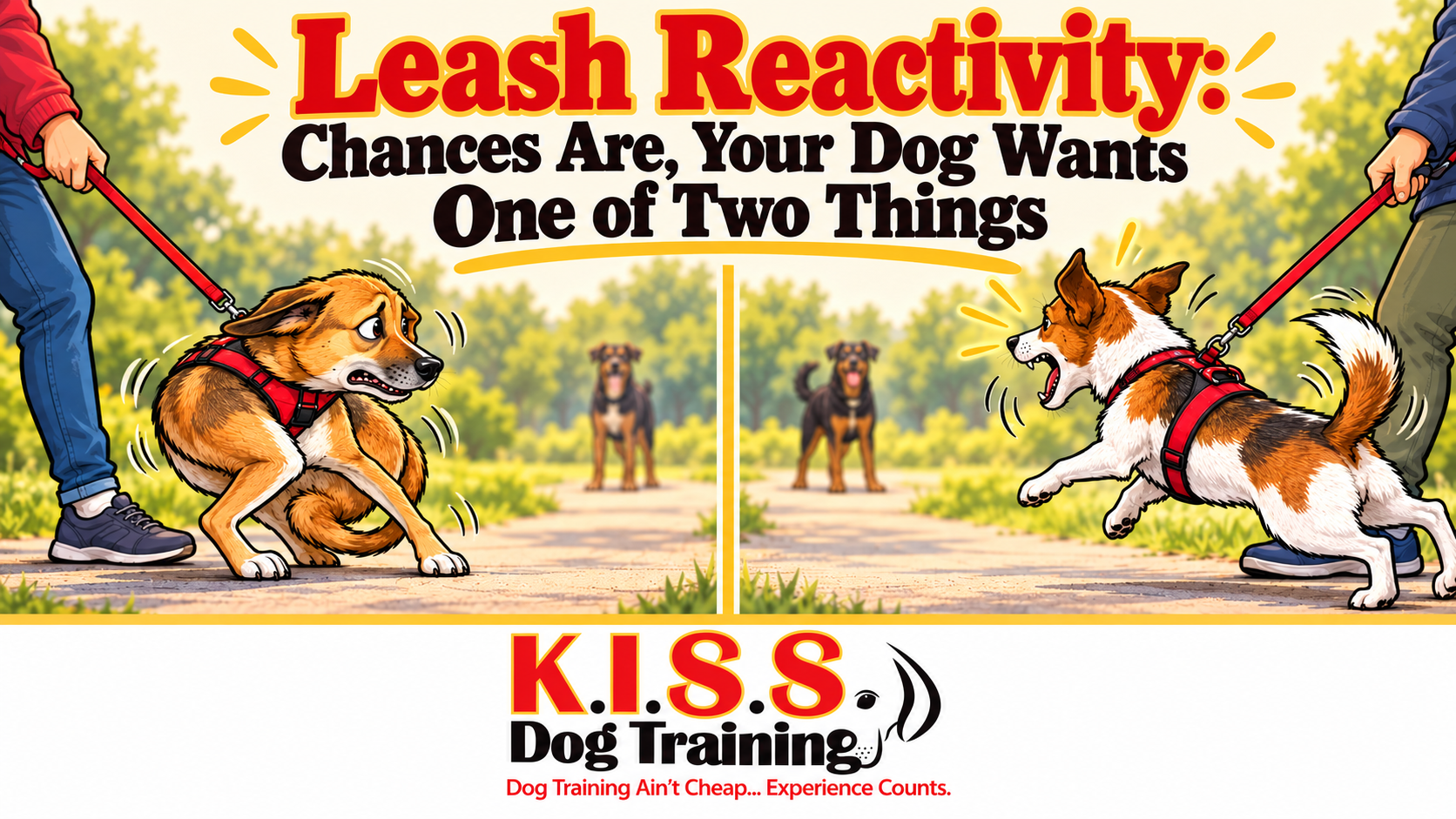
 Leash Reactivity: Chances Are, Your Dog Wants One of Two Things
A leash-reactive dog can turn a simple walk into a wrestling match. It can be embarrassing. It can create stress and tension. And there’s a chance somebody is going to get hurt.
Whether you’re walking the Trolley Track Trail in Waldo, heading around the lake at Legacy Park in Lee’s Summit, or just trying to get around your own block, the problem can look pretty much the same.
Your dog could pull you over or trip you up. If they get loose and run toward another person or dog, somebody else could get hurt. Your dog could get hurt, too—including running into traffic and getting hit by a car.
A leash-reactive dog usually equals nothing good, and a lot of frustration, blisters, and tears.
What You See Doesn’t Tell the Whole Story
But what you see isn’t necessarily what’s going on. And ironically, there’s usually not just one reason that it’s happening. Over my years as a Kansas City dog trainer, I find that in most cases one of two things is going on.
Sometimes the message is, “I need that thing to get away from me.”
Other times it’s, “I want to say hello so bad, I have to get over there.”
Those are very different reasons for reacting. Unfortunately, they can produce what looks like the same outward reaction.
The leash plays a part in both. One dog can’t get away. The other can’t get closer. And you’re standing there holding the leash, trying to figure out what the hell just happened.
A Little Psych 101: Freeze, Flight, Fight
Let’s start with the familiar freeze, flight, fight responses.
When something feels scary, a dog may freeze, try to get away, or try to make the scary thing go away. These aren’t always three steps in a neat order. They’re different ways a dog might respond when they’re uncomfortable.
Now add a leash.
Your dog sees another dog approaching. Maybe they stop moving and watch. Maybe they turn their head or try to move away. But the other dog keeps coming, and the leash limits the options that the dog has to get away.
Freezing hasn’t made the scary thing go away. Now your dog is thinking, “Getting farther away is definitely not an option because I’m attached to this damn leash, and that thing keeps getting closer and closer to me. I’m about to freak out.”
So your dog tries something louder.
Barking. Growling. Lunging. A full performance of Barty Badass, hoping they can bluff their way out of this situation.
It might look like confidence, but underneath it may be fear.
And if the other dog passes or goes the other way, your dog may learn something we don’t want them to figure out: that reactivity might make the scary thing go away.
If the behavior keeps working, your dog has a reason to use it more and more. It becomes a habit—and that’s probably why you’re reading this article.
The Other Side of the Coin
Or maybe your dog wants the exact opposite.
They see another dog and think, “Hey! I want to meet you!”
They pull toward the other dog. You stop them because dragging you down the sidewalk isn’t how you want your dog to say hello.
Well, your choice again limits their ability to do what they want. But in this case, they want to move forward, not get away.
Now their excitement becomes frustration. That frustration can build into anger and what looks like a temper tantrum. And then you see how both of these dogs look identical, or at least pretty damn close, when they’re in the throes of a reactive hissy fit.
An overstimulated dog may even lash out at a nearby dog or person, including the person holding the leash.
Wanting to approach doesn’t automatically make an encounter safe. And barking and lunging doesn’t automatically tell us what started the reaction.
This Is Where a Good Professional Dog Trainer Can Help
The reason behind the reaction matters because it helps us decide how to work on it. That’s an important part of Reactive Dog Training in Kansas City: figuring out what your dog needs instead of treating every barking, lunging dog the same way.
If your dog is excited and wants to say hello, we need to work on frustration tolerance and impulse control. In plain English, your dog needs practice handling the fact that they can’t always get what they want, right when they want it.
For the fearful dog, the starting point is different. At the beginning, we’re going to let them move away. We’re going to try retreating and adding space to see if that helps them feel safer.
At the same time, we’re going to work with a redirection or disengagement cue. That’s a cue that teaches your dog to turn away from the other dog, come back to you, and pay attention to you while the other dog walks away.
We’re teaching the dog, “Hey, look, I got your back. I’ll take care of this. Let me take care of it.”
That might mean using treats with a “leave it” command. That might mean retreating and adding space. The point is to help your dog instead of leaving them to handle the situation by themselves making bad choices such as barking, lunging, or acting a fool.
Both approaches can involve desensitization and counter-conditioning. Those are big words for helping your dog get used to seeing other dogs at a level they can handle and building a more positive response.
One dog needs help with fear. The other needs help with excitement and frustration. Both can learn to disengage and come back to you, but how we get there will be a little different.
That’s where the experience of a good professional dog trainer comes in handy: figuring out what’s going on, finding a starting point your dog can handle, and helping you through the process.
You Can’t Start with the Finished Product
If the bad behavior is already happening on walks pretty regularly, that walk is not a good starting point for teaching these skills.
You can’t start with the finished product. Build a foundation. Then build the walls. Then put in a window. You can’t put a window in unless you have a wall. And you can’t build a wall unless you got a foundation.
So how do you get started? Start in the least distracting environment possible and build from there.
Start in the house.
That’s one reason my in-home dog training in Kansas City starts with you and your dog learning the skills where there are fewer distractions.
Teach your dog what a “leave it” means. Teach your dog to pay attention. Teach your dog that they need you with a hand-feeding protocol throughout the day so that you can practice these skills.
The goal is more than getting their eyes off the object for half a second. It’s giving up that look and looking at you.
And trust me, when I do this kind of training with a client, it can take one, two, even three sessions with two weeks in between before we really get to a realistic outside “leave it” in the backyard.
Not on the walk, keep in mind. In the backyard.
You gotta practice when it’s easy so you stand a chance when it’s hard.
House, Backyard, Driveway, Then the Walk
Once your dog can reliably do the exercise inside, take it to the backyard.
Expect it to get harder. The smells, sounds, and movement outside give your dog more to pay attention to. You may need to make the exercise easier and reward more often.
Then practice in the driveway. Work on paying attention, responding to “leave it,” and turning away with you.
Eventually, take those skills on quieter walks.
You don’t have to march directly toward every distraction to prove your training. In fact, quite the opposite.
Watch your dog. As they start to puff up, as their ears lay back, as their tail tucks, as their hackles come up, your job is to help the dog by adding distance so the dog can make a better choice.
Over time, that distance can become less and less. For the fearful dog, the goal is for seeing another dog to become normal instead of scary.
But if you don’t go through the process slowly, you’re going to force the dog into a situation where they’re going to make a bad choice. And that’s your fault, not the dog’s, if you do it that way.
If your dog can do it in the driveway but falls apart halfway down the block, the next step was too hard. Add space, find fewer distractions, or shorten the practice. Give your dog a chance to succeed before asking for more.
A Little Driveway Practice Goes a Long Way
When your dog is ready to take these skills on a walk, here’s a little trick I use with my clients.
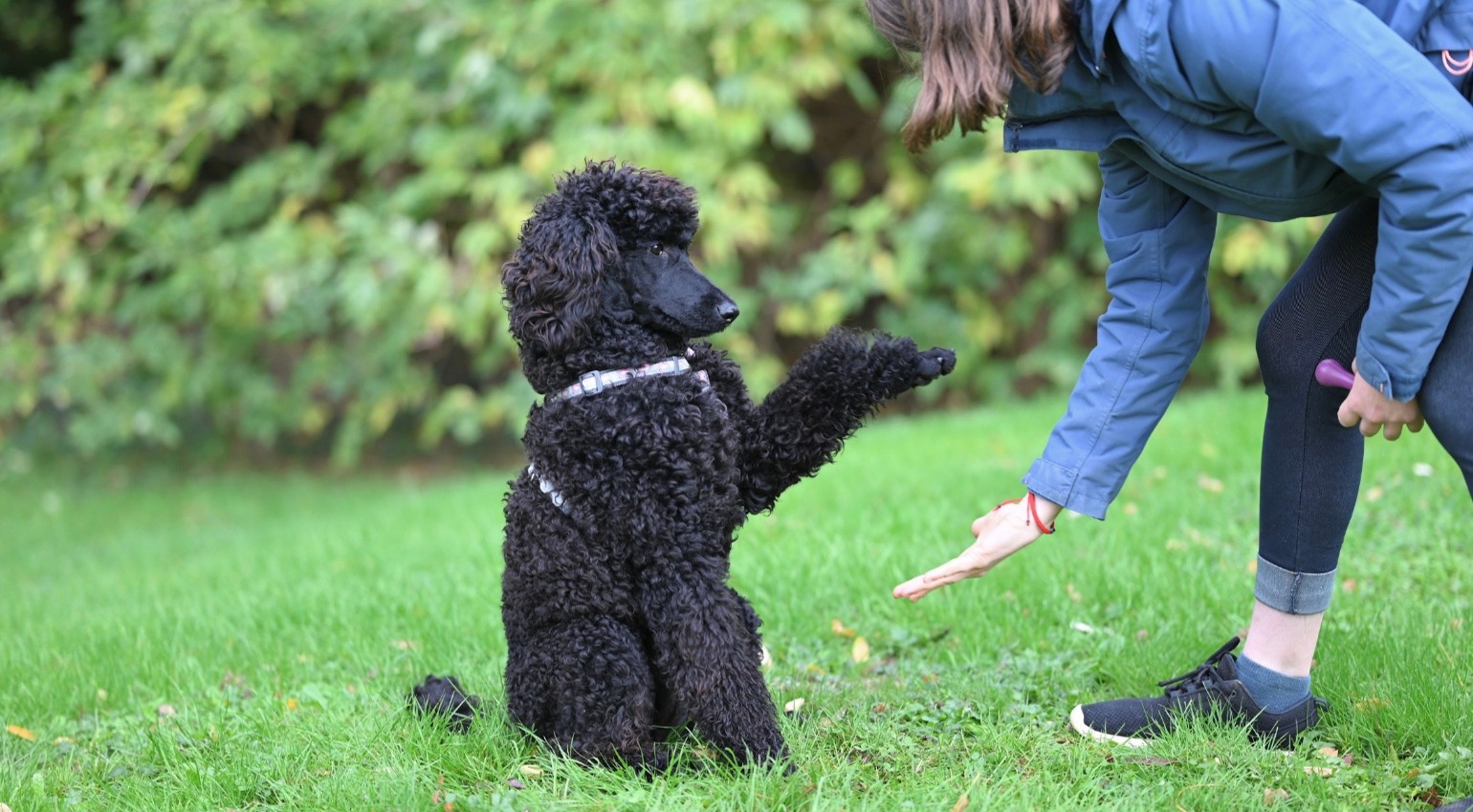
Stop at every driveway and get a sit and a “watch me.” Count five or ten. Release the dog with a treat. Go to the next driveway and do it again.
That gets the dog in the habit of paying attention to you more than the environment. You’re practicing throughout the walk instead of waiting until there’s a problem.
When you can reliably do every driveway, go to every two driveways. Then go to every three.
As that skill gets stronger, you can start saving those reminders for when you notice their attention on something you don’t want it on. You’ve already taught them that paying attention to you is more rewarding.
The cool part about redirection or disengagement is that it can help whether your dog is fearful or overstimulated. You still need to account for what your dog is feeling and give them enough space, but you’ve built a response they know how to give.
And you don’t have to resort to punishing the dog for a bad behavior. You can actually reward them for making the right choice.
If leash reactivity is making your walks miserable, K.I.S.S. Dog Training can help you work on these skills at home and build from there. Tell me what’s going on with your dog, and let’s talk about where to start.







Leave A Comment
You must be logged in to post a comment.