
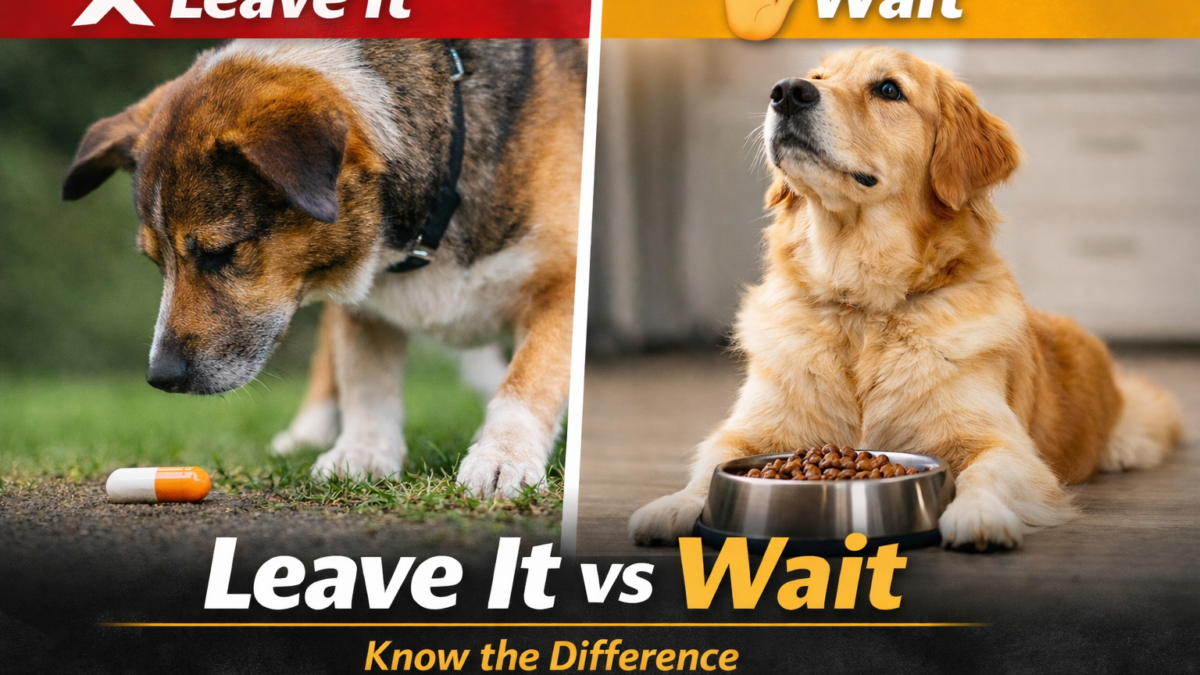
Leave It vs Wait: The Dog Training Difference That Could Save Your Dog’s Life
 Leave It vs Wait: The Dog Training Difference That Could Save Your Dog’s Life
Many dog owners assume Leave It and Wait mean the same thing.
They don’t.
Both commands are useful, but they serve completely different purposes in training.
Understanding the difference can prevent confusion for your dog — and in some situations it could literally keep them safe.
This article is part of a training progression that teaches dogs how to disengage from distractions and redirect their attention back to their handler. If you haven’t already worked on your dog’s attention skills, start here:
https://kissdogtraining.com/watch-me-first-and-foremost/
🐾 Wait, Stay, and Leave It — Three Different Jobs
In my training system, these three commands each do a different job.
| Command | Meaning | Purpose |
|---|---|---|
| Wait | Pause briefly and wait for direction | Everyday impulse control |
| Stay | Hold position until released | Formal obedience |
| Leave It | Disengage, move away, and redirect attention back to the handler | Safety and redirection |
They may sound similar, but the dog should clearly understand three different expectations.
🐾 Think of “Wait” as a Relaxed Version of “Stay”
A lot of people assume Wait and Stay are interchangeable.
They’re not.
The easiest way to think about it is this:
Wait is a relaxed version of Stay.
Stay is a formal obedience command.
Wait is simply a quick pause.
🐾 Wait = A Relaxed Pause
When I say Wait, I’m simply asking the dog to pause for a moment.
Think of it as:
“Whoa… hold on a second.”
The dog pauses briefly, then continues once I allow them to move forward.
I don’t use a formal release word here.
Instead I’ll usually say something casual like:
• go ahead
• get it
• okay
It’s simply a relaxed pause to prevent the dog from rushing ahead of me.
Examples include:
• Wait before walking through a doorway
• Wait before jumping out of the car
• Wait before eating
• Wait at the top of the stairs
In these situations the dog pauses briefly, then goes ahead once I allow them to continue.
🐾 Stay = Hold Until the Release Word
Stay is much more strict.
When you say Stay, the expectation is clear.
The dog should hold their position until they hear the release word.
In my training system that release word is:
“All done.”
Some trainers use words like:
• OK
• Free
• Break
• Release
But the rule stays the same.
The dog does not move until they hear the release word.
🐾 “Thank You” Means Something Different
In my training system, “Thank you” is not a release word.
It’s a positive marker.
It simply tells the dog:
“Yes, that was the correct behavior.”
The exercise may still continue after that.
Only “All done” tells the dog the exercise is finished.
🐾 Leave It Means Something Completely Different
Now let’s talk about Leave It.
Leave It is not about pausing.
It’s about disengaging.
When a dog hears Leave It, the message should be:
Stop focusing on that, move away from it, and redirect your attention back to the handler.
The goal is for the dog to move away from the object and check back in with the handler for the next direction.
🐾 One Command Means “You’ll Get It” — The Other Means “Never”
One of the biggest reasons I keep Wait and Leave It separate is clarity.
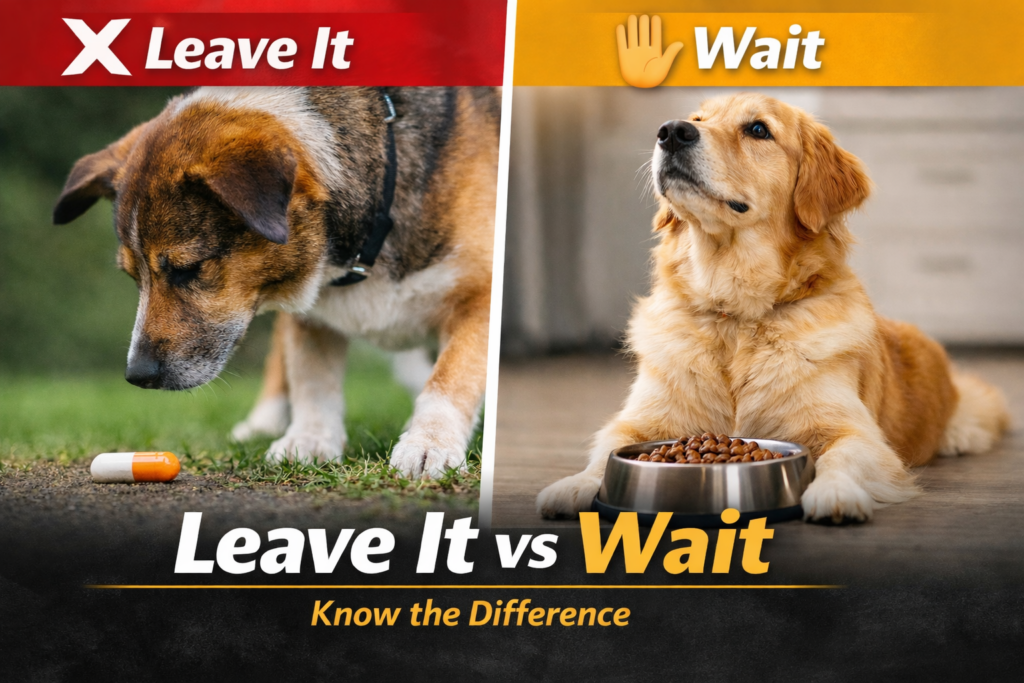
With Wait, the dog is usually pausing before getting access to something.
For example:
You put a food bowl on the floor and say Wait.
The dog pauses.
Then I might say “go ahead” or “get it.”
Now the dog is allowed to eat.
The pause helped control impulse, but the dog still gets access to the food.
Leave It works completely differently.
If I drop a blood pressure pill on the floor and say Leave It, the dog is never going to get that pill.
Instead the dog should:
• disengage from the object
• move away from it
• redirect back to the handler
• check in for the next direction
At that point I can safely pick up the pill, and then reward the dog with something appropriate.
That distinction matters.
Wait = pause, then go ahead.
Leave It = disengage and move away because access is not happening.
🐾 Teaching the Leave It Command
The goal of Leave It is simple:
The dog learns to disengage from something and redirect back to the handler.
I usually teach this in stages.
🐾 Step 1 — The Hand Exercise
Start by placing a treat on the ground and covering it with your hand.
Your dog will naturally investigate your hand because they know the treat is there.
As they investigate, calmly say:
“Leave it.”
Then immediately toss a different treat away from your hand.
Your dog moves away from the covered treat to go get the tossed reward.
This teaches the first important lesson:
Moving away from the object leads to something better.
🐾 Step 2 — The Foot Exercise
Once the dog understands the hand version, place the treat on the ground and cover it with your foot instead of your hand.
The dog will investigate your foot.
Say:
“Leave it.”
Instead of tossing a treat away, wait for the dog to look up at you.
The moment the dog makes eye contact, reward them from your hand.
Now the dog is learning something important:
Leave the object → check in with the handler.
🐾 Step 3 — Controlled Distraction
The next step is to practice with bigger temptations.
Put the dog on leash.
Have someone place a small pile of treats on the ground a short distance away.
As the dog moves toward the pile, use the leash to prevent them from reaching it and say:
“Leave it.”
Keep your reward hand down by your side so the dog can see it when they turn.
When the dog disengages from the pile and looks back at you, reward them and allow them to move toward your hand.
Now the dog learns the full behavior chain:
Disengage → move away → check in with the handler → get rewarded.
🐾 Step 4 — Build Real-World Distractions
Once the exercise works indoors, begin gradually increasing distractions.
For example:
• practice inside the house
• move to the backyard
• work around the neighbor’s dog through a fence
When working near another dog, make sure there is plenty of distance between the dogs.
If both dogs start right up against the fence, the level of excitement and stimulation will be so high that neither dog will be able to focus or learn.
Instead, start far enough away that your dog can still think and respond to you.
Then gradually decrease the distance as your dog improves.
From there you can continue progressing:
• practice in the front yard
• practice in the driveway
• begin short walks
• add distractions like people, joggers, strollers, and other dogs
Each step simply raises the level of distraction while reinforcing the same behavior.
🐾 Practice the Leave-It Progression
Once your dog understands the basics, you can practice the skill in real-world training exercises:
https://kissdogtraining.com/leave-it-on-leash/
https://kissdogtraining.com/leave-next-step-car/
https://kissdogtraining.com/leave-it-at-a-park/
https://kissdogtraining.com/park-bench-bingo/
🐾 Consistency Matters More Than Time
This exercise doesn’t require huge amounts of time.
But it does require consistency.
If you practice regularly and gradually increase distractions, your dog will begin to understand the rule:
Disengage from the distraction and check back in with the handler.
🐾 Dog Training Help in Kansas City
If you’re struggling to teach commands like Leave It, Wait, or Stay, working with a professional trainer can make the process much easier.
As a dog trainer in Kansas City, I work with owners in real homes and real environments to build reliable behaviors like disengagement, impulse control, and focus around distractions.
Learn more about in-home training here:
https://kissdogtraining.com/dog-trainer-kansas-city/
Winner – Best Dog Trainer in Johnson County (2023, 2025)
https://bojc2025.johnsoncountypost.com/pets/dog-trainer
🐾 Why Leave It Can Be a Life-Saving Command
Dogs explore the world with their noses and mouths.
That means they will eventually encounter things that aren’t safe.
Teaching your dog to disengage, move away from objects, and check back in with you for direction can prevent dangerous situations.
It’s one of the simplest commands you can teach — but it can also be one of the most important.
If your dog clearly understands the difference between Wait, Stay, and Leave It, communication becomes much clearer in everyday life.
And sometimes, that clarity really matters.
Tags In
Related Posts



Search Blogs
Most Popular Posts
K.I.S.S. Dog Training proudly serves the Kansas City Metro, Overland Park and Surrounding Areas. 40 miles, 20 miles each way from Shawnee, KS is included for In-Home Sessions... Over that mileage is an additional charge of $1.00 per mile... Call with Questions
Contact Us Today!
K.I.S.S. Dog Training
Shawnee, Kansas
(913) 269-7595