If the only time you use the crate is when you leave the house or go to bed, the crate becomes associated with one thing:
Losing the family.
That’s not what we want.
The goal is to make the crate a normal part of everyday life — paired with good things, especially food.
The Common Mistake
Many people feed their dog in the kitchen next to the water bowl instead of in the crate.
If the best parts of the day involve food… why wouldn’t the crate be part of that?
Put the food bowl in the crate.
Now the dog associates:
Going into the crate
Being inside the crate
Getting fed
That’s how positive associations are built.
Crate Location Matters
The crate should not be isolated in a back bedroom or basement.
In most homes, the best location is between the kitchen and living room — where life actually happens.
The dog can see you. The dog can hear you. The dog is part of things — but not unsupervised.
If your dog sleeps in a crate in the bedroom, that’s fine.
Have:
One crate in the bedroom for sleeping
One crate in the main living area for daytime routines
🐾 How Long Should I Crate My Dog?
On average, I crate train for 1–2 years to move safely through adolescence.
That does not mean long confinement. It means structured management during developmental stages.
Most dogs aren’t fully mature until 2–2½ years old.
A one-year-old dog loose in the house still requires serious proofing before I trust the furniture 🙂
🐾 4 Crate Routines That Build Calm
1️⃣ The Door Routine
When the doorbell rings or someone knocks:
→ Lure your dog to the crate → Reward → Then answer the door
This teaches:
Don’t rush the door
Don’t jump on guests
Go to your spot when excitement happens
When guests leave:
→ Crate the dog → Let everyone exit → Release calmly
This prevents chaos, escapes, and door bolting.
2️⃣ Pair It With Every Human Meal
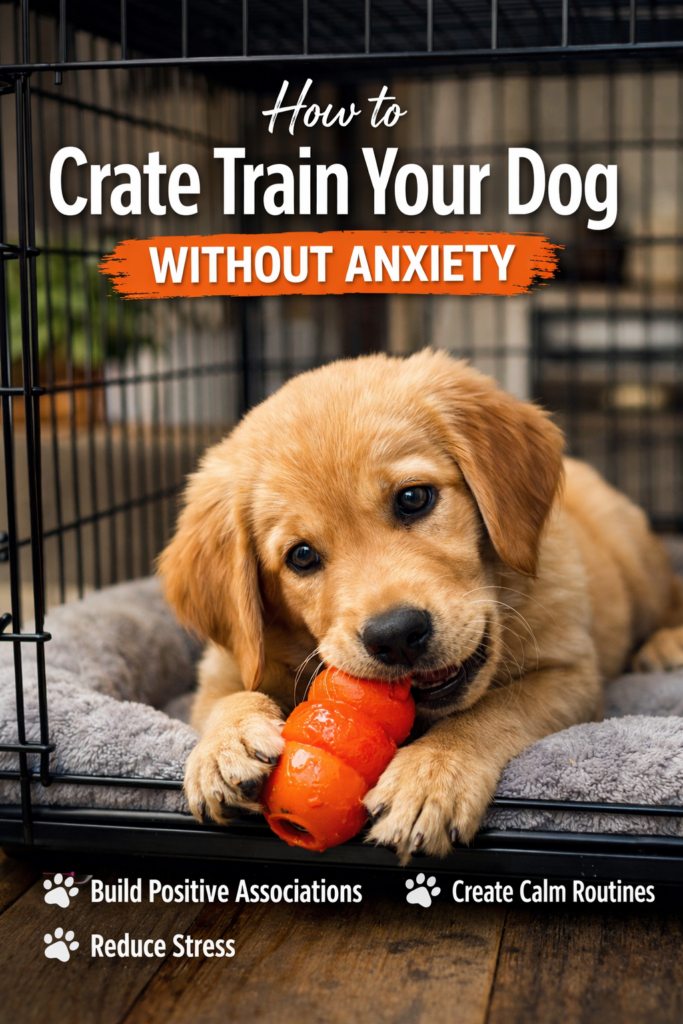
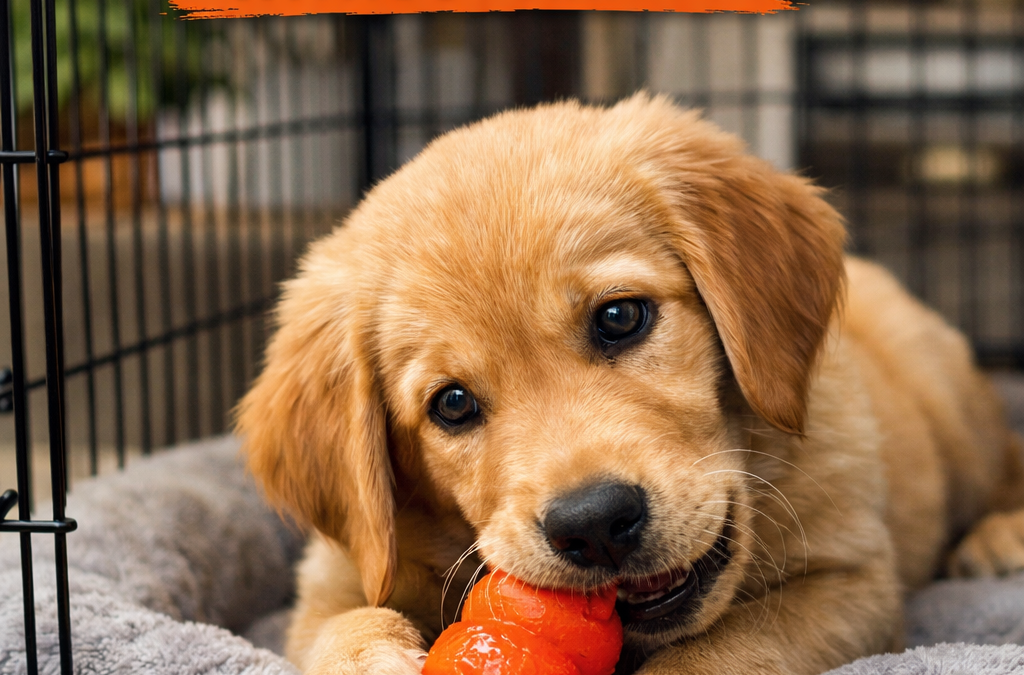
Every time you eat, your dog goes to the crate with a stuffed Kong.
80% dog food 20% binder (peanut butter, yogurt, pumpkin, applesauce)
Freeze it so it lasts longer.
3️⃣ One TV Program Per Evening
Pick one 30-minute show.
Dog goes in crate. Dog gets a Kong.
This builds:
Independence
Calm behavior
Self-entertainment
4️⃣ The Shower Routine
Shower = crate time.
In with a Kong. Out calmly when you’re done.
Quick repetition. No drama.
⚠️ A Quick Note About Kongs and Calories
If you’re using multiple Kongs throughout the day (meals, TV time, shower routine), that food must come out of your dog’s total daily ration.
Do not feed a full bowl and multiple full Kongs.
Adjust the daily amount accordingly.
Otherwise, your calm, well-trained dog may turn into a sausage with feet 🙂
🐾 Go Slow and Keep It Simple
What’s easier for a dog?
One long 30-minute stretch… Or ten short, positive repetitions?
Short wins.
You’re building:
Crate = reward Crate = safe Crate = predictable
Not:
Crate = stuck
Practice short real-life departures:
Take out the trash
Grab coffee
Pick up a prescription
Run to the gas station
Be gone 3–10 minutes.
Return calmly.
Every time you leave… you come back.
That lowers anxiety. That builds confidence. That makes the crate predictable instead of scary.
🐾 Normalize the Leaving Cues
Dogs react to patterns.
Keys. Wallet. Garage door. Purse. Phone.
Those signals predict departure.
So rehearse them.
Pick up your keys and set them down. Open and close the garage. Grab your purse and walk into another room.
Make those cues boring.
When departure isn’t dramatic, anxiety drops.
Crate training isn’t confinement. It’s structure and predictability.
🐾 Crate Training Help in Kansas City
If you’re struggling with crate training and want hands-on help from a professional dog trainer in Kansas City, structured in-home support can make the process smoother and far less stressful for both you and your dog.
Through practical, real-world in-home dog training Kansas City families rely on, we help you:
Place the crate in the right location
Build routines around your real daily life
Normalize departures so your dog isn’t guessing what’s coming next
Make the crate part of life — not a signal that the family disappears.
Once your dog is comfortable in the crate, the next step is teaching them how to relax outside the crate on a bed or mat — something I walk through step-by-step in How to Teach Your Dog to Settle: From Crate to Bed to a Reliable Stay.
K.I.S.S. Dog Training proudly serves the Kansas City Metro, Overland Park and Surrounding Areas. 40 miles, 20 miles each way from Shawnee, KS is included for In-Home Sessions... Over that mileage is an additional charge of $1.00 per mile... Call with Questions
 🐾 How to Crate Train Your Dog Without Anxiety