Teaching Leave-It: How Dogs Learn to Disengage and Choose You Instead
 🐾 Teaching Leave-It: How Dogs Learn to Disengage and Choose You Instead
In the previous blog, Dog Trainer in Kansas City Explains Why Your Dog Isn’t Listening, we focused on building attention and engagement through hand-feeding and structured games. That foundation matters, because a dog cannot ignore distractions or make good choices if they don’t already know how to stay connected to their handler.
If you haven’t read it yet, start with Dog Trainer in Kansas City Explains Why Your Dog Isn’t Listening to understand how attention and engagement are built before obedience cues are introduced.
Once attention exists, the next skill to build is Leave-It.
Leave-It is not about control, force, or punishment. It is a redirection cue that teaches a dog how to notice something in the environment, disengage from it, and choose their handler instead.
This skill bridges the gap between “my dog can focus at home” and “my dog can listen when real life happens.”
🐾 Why Dogs Struggle With Disengagement
Dogs are hard-wired to notice movement, smells, sounds, and novelty. That isn’t bad behavior — it’s biology.
The problem isn’t that dogs notice distractions. The problem is that most dogs are never taught where their attention should go next.
Without that clarity, dogs often:
- Fixate
- Lose connection with their handler
- React to other dogs, people, places, or things — especially on walks
Once fixation sets in, dogs can quickly become overstimulated. That over-stimulation often shows up as barking, lunging, or reactivity, followed by difficulty calming back down.
At that point, the dog isn’t choosing to ignore the handler — their nervous system has taken over.
Leave-It fills this gap by teaching dogs how to disengage before fixation turns into over-stimulation and by showing them that turning back to their handler is both safe and rewarding.
This is a perfect example of why being proactive in dog training matters. Addressing a situation before it escalates is far more effective than trying to fix a problem after it has already happened — especially when the response is punishment. Proactive training builds skills that prevent problems; reactive responses simply deal with the fallout.
🐾 What Leave-It Really Means (and What It Doesn’t)
Many people misunderstand Leave-It.
Leave-It does not mean:
- “Stop wanting that forever.”
- “You’re wrong for noticing that.”
- “Ignore everything in the world.”
Leave-It does mean:
- The dog notices a distraction
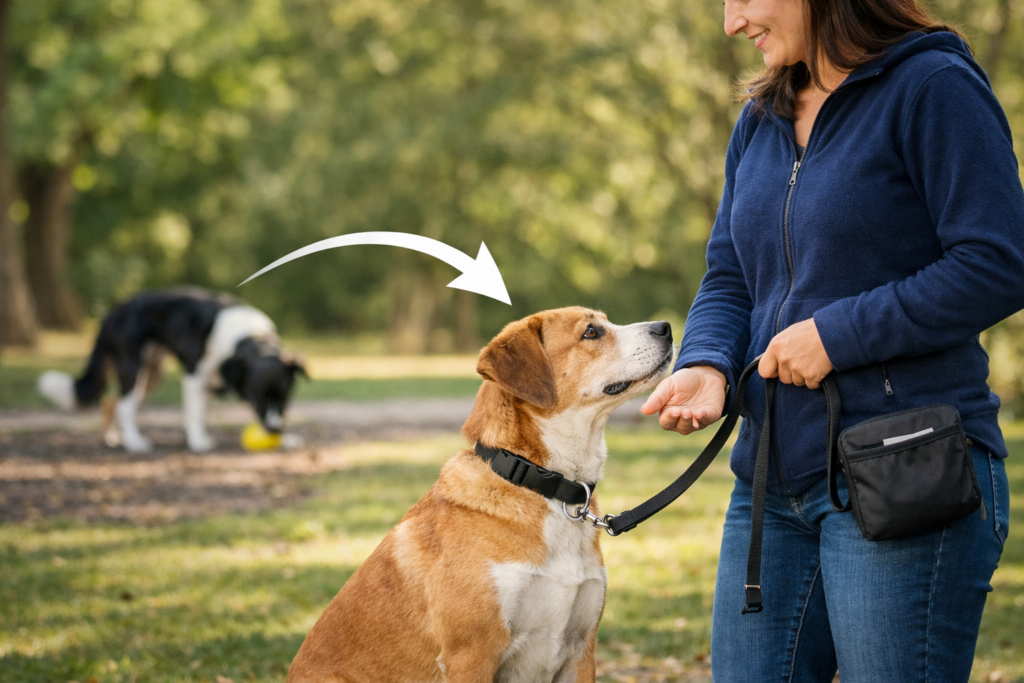
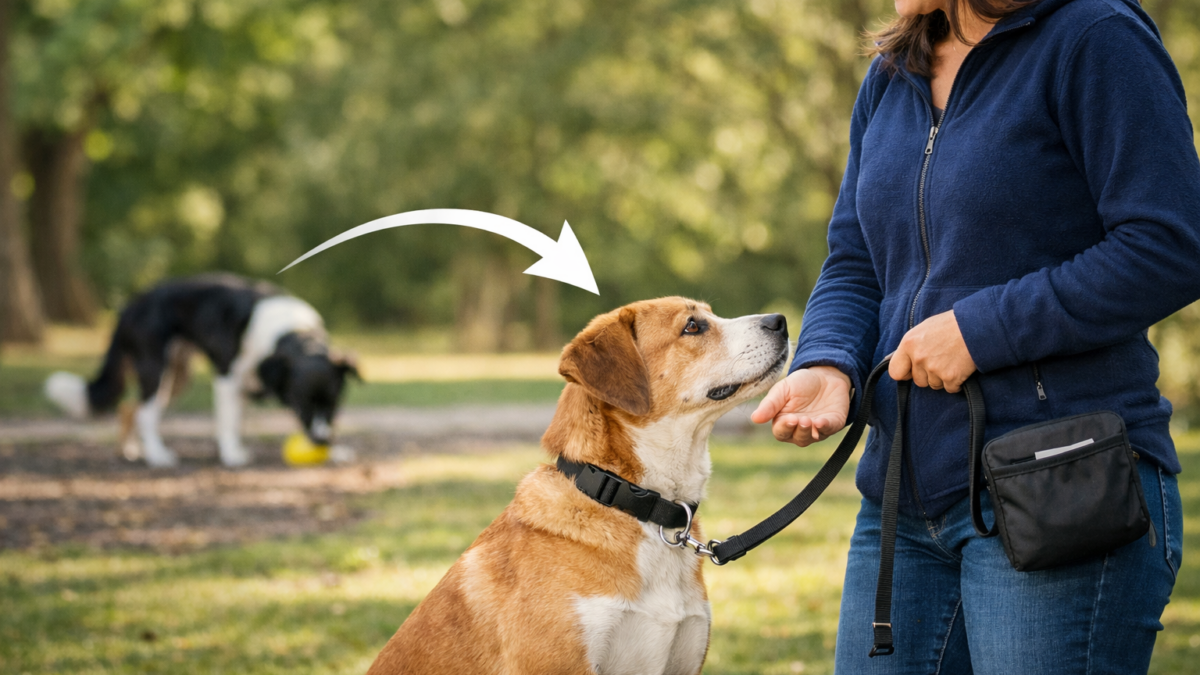
- The handler gives the verbal cue “Leave-It” while simultaneously dropping their hand to their side with a reward
- The dog turns away from the distraction and looks back at the handler
- The dog re-engages to earn that reward
Leave-It teaches orientation and attention, not hesitation.
Your dog is allowed to notice the world. The skill is learning that the cue and hand signal together mean turn back to the handler, because that’s where reinforcement lives.
🐾 How Leave-It Is Taught Correctly
Leave-It is a taught skill, not a magic word, and not something you shout once the dog is already overwhelmed.
The handler actively teaches this skill, starting in environments where the dog can succeed.
The verbal cue “Leave-It” and the handler’s hand dropping naturally to their side happen at the same time, forming one clear picture for the dog. The hand drop includes the reward and gives the dog an immediate, visible reason to turn back and re-engage.
This is the same motion used when:
- Calling a dog to you for a reward
- Releasing a dog from a stay
The learning sequence is simple and consistent:
- The dog notices something
- The handler gives the cue and hand signal simultaneously
- The dog turns away from the distraction and looks back
- The dog re-engages with the handler
- The dog is rewarded every single time for that choice
When Leave-It is being taught, re-engaging always equals a food reward. The behavior needs a paycheck.
Important timing detail:
If the handler says the cue but delays the hand signal — for example, digging for a treat afterward — many dogs lose patience. Without immediately seeing the reward, they often look back at the distraction and continue fixating or becoming overstimulated. This is why the verbal cue and hand signal must happen together.
Eventually, other rewards can replace food — praise, movement, access to the environment — but only after the skill is fluent. You don’t fade rewards before the behavior exists.
🐾 One Hand Signal, Multiple Skills
Here’s the sneaky — and powerful — part:
Leave-It, Come When Called, and releasing a dog from a stay all use the same hand signal — the handler’s hand dropping naturally to their side, followed by a reward.
That consistency helps dogs learn faster, respond more reliably, and generalize skills more easily.
What looks subtle is actually smart training — using one simple, natural movement as a multi-purpose communication tool.
🐾 Building the Skill Through Environments
Leave-It isn’t proofed by pressure. It’s proofed by changing environments gradually.
Once the dog understands the skill inside the house, the picture changes — not the rules:
- Inside the house
- Backyard
- Front yard or driveway
- Short, controlled walks
Distractions are added only after success at the previous level.
If the dog struggles, that’s not failure. It’s feedback. The answer isn’t correction — it’s making the environment easier again until the dog can succeed.
This step-by-step process is where working with an experienced In-Home Dog Training in Shawnee professional can be especially helpful when teaching reliable skills in the home environment first.
🐾 When Leave-It Isn’t Enough on Its Own
Some dogs struggle with fear, anxiety, reactivity, aggression, or extreme over-arousal. In these cases, Leave-It is still useful — but it often needs to be part of a broader, structured training plan that addresses emotional regulation, not just behavior.
If you’re dealing with these challenges and need additional support, working with a qualified Dog Trainer in Kansas City can help you and your dog move forward safely and effectively.
🐾 Coming Up Next: When Should I Stop Using Treats?
Once dogs learn to disengage and re-orient to their handler, owners naturally ask:
“When should I stop using treats?”
That question matters — and it deserves its own conversation. That’s exactly what we’ll cover next.
If you’re ready to take the next step or want help applying these skills in your home, you can reach out through our Contact Us page to learn more about in-home dog training options.