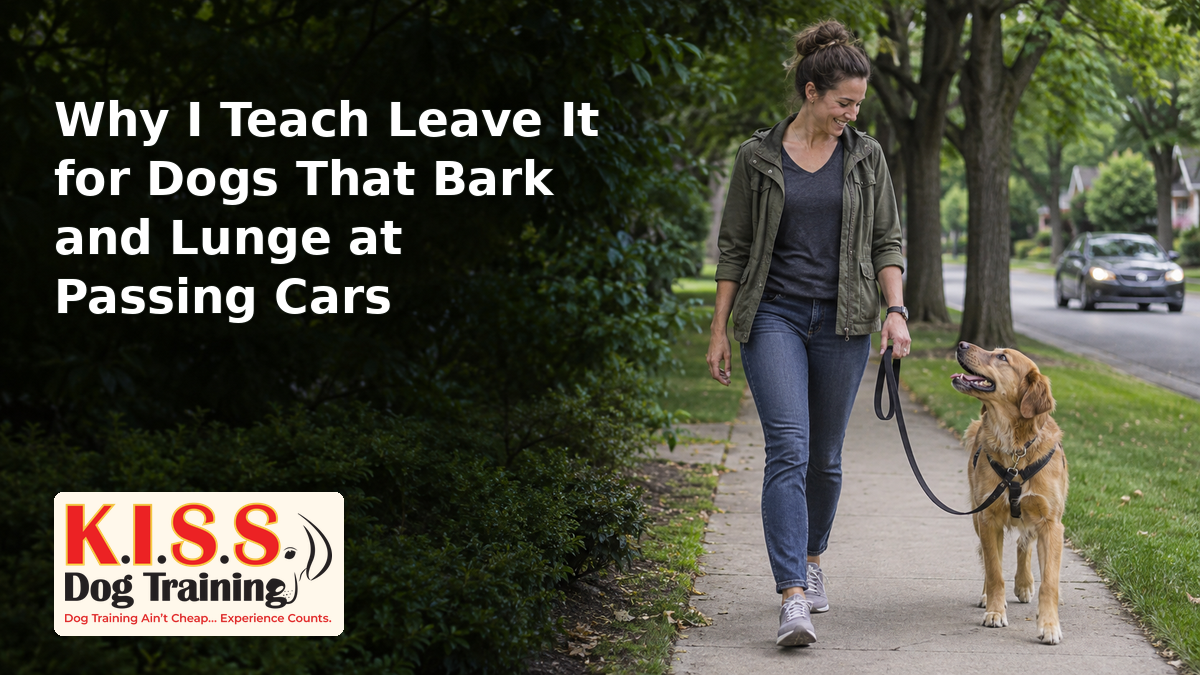
Why I Teach Leave It for Dogs That Bark and Lunge at Passing Cars
You’re out walking your dog when a car comes down the street. Your dog spots it, hits the end of the leash, and starts barking. You know what you want them to stop doing. The question is, what do you want them to do instead?
What I really want is for a passing car to become ordinary enough that the dog can see it without getting so wound up that they feel the need to react. The same goes for any other distraction that gets them worked up. To help them get there, I teach the dog to turn away, come back to me, and get a reward for focusing on me instead of whatever caught their attention. That’s a skill we can practice before we ever need it on a walk.
Back in 2014, a client asked me what to do when their dog barked and pulled on the leash every time a car went by. I recorded a video about it. That was twelve years ago, and I was a hell of a lot skinnier.
Take a minute and watch the video It’s only about five minutes, and you’ll see how I dealt with it in 2014. Then come back and finish this blog to see what I use today.
🟨“Video Blog 6/14/2014 Barking & Pulling When They See a Moving Car.”🟨
What I Was Doing With the Clicker in 2014
Back in 2008 when I started training dogs I worked at PetSmart, I used a clicker as a positive marker. The click predicts a reward and marks a correct behavior that the dog has just performed. If I ask for a sit, I click the instant the dog’s butt touches the floor, then I give the dog a treat. It tells the dog exactly what earned the reward, and repeatedly rewarding that process makes the dog more likely to do it again.
In the video, I used the clicker a little differently. I took advantage of a distinctive sound that could get the dog’s attention. I wanted that sound to mean “Focus on me and get a reward.”
In either case, you have to load the clicker first. During a quiet hand-feeding session, I’d go click, treat, click, treat. Once the dog started turning toward me when they heard the click, I could try it in the backyard. I’d click, drop my hand to my side with the reward, and give it to the dog when they came back to me. All of that happened before I ever tried it around traffic.
Then, when a car went by, I could click as the dog noticed it. Catch the look, not the bark. The familiar sound would get the dog’s attention, and I could reward them for turning back to me. Now the dog had something else to do besides barking and pulling after the car.
Now, I don’t want to get all psychobabble. Yes, I have a degree in psychology. Yes, I’m a certified dog trainer who had to learn a lot about Skinner and Pavlov. Most people just want to know what to do when their dog goes nuts on a walk. Fair enough.
For those who are interested, a positive mark is a bridge from the behavior you wanted to the reward. It helps the dog make the connection that they made the right choice. In the video, I’m using the clicker as a bridge to a command. The sound itself is the cue for Watch Me Command (Don’t look at that look at me). It’s a slight difference, but it explains how I got from what I did then to what I teach now.
How I Teach It Today
Somebody drops something. I say Leave It, and the dog comes back to me for the reward. I can then pick up the item that was dropped on the ground. Somewhere along the way, I saw the connection between what I’d been doing with the clicker and what my clients wanted their dogs to do around distractions.
Over the years, I also noticed that people liked the clicker, but they rarely had it on them when they needed it. Having to carry another piece of equipment got in the way of practicing new things. So I took a command I was already teaching and gave it a bigger job.
I expanded Leave It to mean “Quit looking at that. Look at me.” That could be a dropped piece of food, a squirrel, a person walking by, or a car.
Here’s what that looks like when I practice it. I say Leave It. When the dog turns back to me, I call them all the way back and ask for a sit. Then I bring the reward up to my face and say Watch Me. I count to five in my head. One, two, three, four, five. Then I release the dog to take the reward from my hand.
Here are a couple of videos of how to get things started:
If you’d like a written walkthrough to go with the videos, here’s how I teach dogs to use the Leave it Command
🟨Leave It around distractions🟨.
Practice When It’s Easy
I don’t care if you say Leave It, Eyeballs, or Attention. You could use a distinctive sound. What matters is that you’ve taught your dog what to do when they hear it. You gotta practice when it’s easy so you stand a chance when it’s hard.
Start in the house. Try it in the backyard. Then, when you’re ready to work around passing cars, start somewhere safely away from traffic where your dog can notice a car and still turn back to you. If they’re already barking and lunging, move farther away and give them a chance to settle. Next time, start with more room.
As a 🟨dog trainer in Kansas City🟨, I help owners figure out where to start when leash reactivity makes it hard to get around their own block. Sometimes we practice in the driveway first, where we can step back from the street and give the dog enough room to pay attention.
Over time, those easy repetitions help passing cars become a more ordinary part of the walk. That’s what I mean by getting your dog used to them. The car can go by, your dog can look back at you, and the two of you can get on with your walk.
Over the years, I’ve come to think of Leave It, or whatever you call your redirection cue, as pretty much the apex command most people who own a dog need and want. Maybe your dog is reacting to a passing car. Maybe they’re wound up over a squirrel or staring at somebody across the street. In any of those situations, it’s handy to be able to say, “Quit looking at that. Come back and pay attention to me.”
If you have any questions, please fill out the following form:
Keep it simple, stupid.
Mike







Leave A Comment
You must be logged in to post a comment.