Let Them Check Their Pee Mail: Why Sniffing Matters in Dog Training
Over the years, several veterinarians have talked with me about how much better dogs can smell than we can. One example that has always stuck with me is chicken soup.
You walk into a house where chicken soup is cooking, and it smells good. Your mouth starts watering. You get hungry. You’re thinking about a bowl of soup.
Your dog may be getting a much more detailed picture: chicken, celery, carrots, and other smells that blend together into “soup” for us.
Now, that doesn’t mean your dog can hand you the recipe or tell you there are exactly two bay leaves in the pot. It’s an illustration of how differently a dog can experience the same environment.
And if their noses give them access to that much information, shouldn’t that change how we approach training?
There’s More Going On Than We Can Smell
You’ll hear all sorts of numbers about how many times better a dog’s nose is than ours. I’m not going to hang this discussion on one impressive-sounding number. What a dog can detect depends on the odor, the individual dog, the conditions, and the task.
But the physical differences are impressive enough.
Research into canine nasal airflow shows that air entering a dog’s nose follows separate breathing and smelling pathways. The structure helps deliver odor to the sensory region and retain it there while the dog breathes out. Their noses are built to collect information in ways ours aren’t.
Another study used computer simulations to compare sniffing with quiet breathing. Sniffing delivered about two and a half times as much air to the smell-processing region of the nose and increased the uptake of certain odor molecules. That comparison is between a dog sniffing and breathing normally—not between dogs and people. But it helps explain why that little working nose matters.
The sidewalk you think is boring may be anything but boring to your dog.
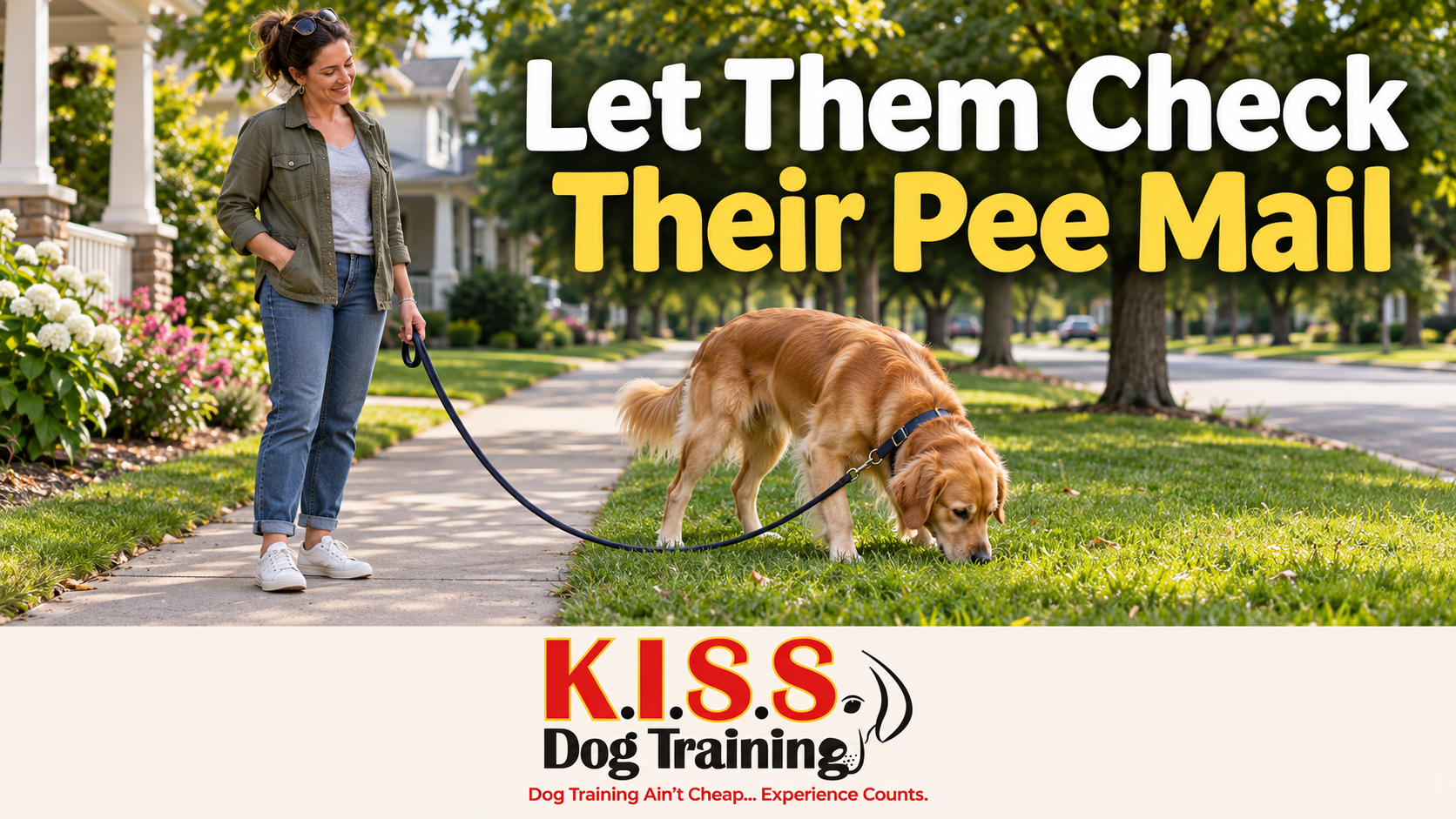
You see a patch of grass. Your dog has found something worth investigating.
Whether they’re sniffing the grass or a spot on the concrete, your dog may be checking their pee mail. And the marking or pooping that follows might very well be replying to that email—or leaving an attachment.
Before we decide that dog is being difficult, we need to consider what we’re asking them to ignore.
Would You Go to a Party Wearing a Blindfold?
Imagine walking into a party wearing a blindfold.
Everybody else can look around, recognize people, and see what’s happening. You’re being asked to participate without access to a major source of information.
That would be uncomfortable, wouldn’t it?
That’s the comparison I want people to consider when they become so strict about walking that their dog is never allowed to stop and sniff.
We rely heavily on our eyes. Smell is a major way dogs investigate their world. They still use their eyes and ears, of course, but insisting that they ignore every smell overlooks something important about being a dog.
Cornell’s veterinary guidance specifically recommends giving dogs opportunities to sniff during walks, explore safely, and experience different routes. Those opportunities are part of enrichment—letting dogs express natural behaviors that matter to their welfare.
If the walk is supposed to benefit the dog, shouldn’t using their nose be part of it?
Make Room for Little Sniffing Safaris
I think dogs should get little sniffing safaris on their walks.
Let them investigate a safe patch of grass. Let them spend a little time checking out that interesting smell. Give them opportunities to be dogs.
Whether you’re walking through your neighborhood in Shawnee or Overland Park, dog sniffing on walks is something to make room for, rather than treating every stop as an interruption.
That doesn’t mean they get to drag you down the sidewalk or investigate something dangerous. It also doesn’t mean you have to stand beside one mailbox for the rest of the afternoon.
A dog still needs to be redirectable.
That’s where a taught Leave-It or disengagement cue comes in. When it’s time to move along, we need to be able to ask the dog to leave that smell and come with us.
Then there can be another opportunity to sniff farther down the walk.
We can have expectations and still make room for the things our dogs enjoy. A walk can include moving together, paying attention, practicing skills, and stopping to investigate.
People who become so militant about the walk that the dog never gets to be a dog are missing a big part of the point.
Watch What Happens When the Wind Changes
Here’s another situation I point out to clients.
You’re working with your dog outside. Maybe you’re practicing attention or trying to apply something the dog already does well in the house.
Then the wind changes.
Your dog turns their head toward it. Their nose lifts, their nostrils start working, and suddenly you seem a whole lot less interesting.
They may be air scenting—sampling odors carried on the breeze.
From the owner’s end of the leash, it can feel like the dog has stopped listening altogether. Their other senses haven’t literally shut off, but their attention may be heavily occupied by something you cannot even detect.
That matters when we’re judging their response.
You might be thinking, “Nothing changed. Why won’t you listen?”
Something may have changed considerably for the dog.
Disengaging From a Smell Takes Practice
Being able to perform a skill in the living room doesn’t automatically mean your dog can do it while investigating an exciting scent outside.
That’s why I want owners to build skills gradually.
Teach the dog what the cue means in an easier setting. Reward them for responding. Then practice with manageable distractions before expecting the same response around something much more compelling.
For an exercise that helps establish that foundation, see How to Get Your Dog’s Attention: Teach “Watch Me”.
If we wait until the dog is completely absorbed in a smell to start teaching disengagement, we’ve made the job harder than it needs to be.
With experience and practice, dogs can become better at shifting their attention back to us. But that ability needs to be taught and maintained.
Practice when it’s easy so you stand a chance when it’s hard.
Let Their Nose Change Your Expectations
When I’m working with a dog, I want the owner to consider what that dog is experiencing before deciding the dog is stubborn or the training isn’t working.
That’s an important part of my approach as a dog trainer in Kansas City: helping owners recognize the distractions their dogs experience, including the ones we cannot smell.
Sometimes we’re asking for attention in an environment that is much harder than we realize. Sometimes we’ve spent the entire walk preventing the dog from doing one of the things that makes going outside worthwhile.
Understanding their nose should help us make better training decisions.
Give your dog opportunities to sniff. Teach them how to disengage. Build your expectations through practice, and recognize that an interesting smell can be a substantial distraction.
The goal is a dog who can enjoy exploring the world and still respond when you need them.
And sometimes, getting there starts with letting them stop and smell it.
If you need help applying this to everyday walks, explore K.I.S.S. Dog Training and my approach to in-home dog training. For dog training in Kansas City and the surrounding metro, tell me what’s going on with your dog so we can discuss whether I’m the right fit to help.





Leave A Comment
You must be logged in to post a comment.